
What is transport orchestration, and why is it becoming more important?
What do we mean by transport orchestration? At Simacan, we use the term transport orchestration for the operational layer that connects people, processes and systems across organisational boundaries. It creates one shared operational view in which information from different sources becomes directly usable. That helps everyone involved make better decisions together.
Internationally, the term transport orchestration is also widely used. It is our way of describing real-time collaboration during transport execution.
From fragmented information to one shared operational view
Is transport orchestration the same as supply chain orchestration?
Why this matters now
FAQ about transport orchestration
What is transport orchestration?
At Simacan, we use the term transport orchestration for the operational layer in our platform that connects planning, execution and collaboration across systems and organisations. This creates one shared operational view in which information from different sources can be used immediately to make better decisions together. In Dutch, we use the term transport coordination (transportcoördinatie) to describe the same concept.
Is transport coordination the same as transport orchestration?
Yes, broadly speaking.
Transport orchestration is the term that is increasingly used internationally. At Simacan, we use transport orchestration to describe the real-time coordination of people, processes, systems and information during transport execution. In Dutch, we use the term transport coordination (transportcoördinatie) to describe the same concept.
The exact interpretation of these terms varies between providers, and there is no universally accepted definition.
What is the difference between transport orchestration and supply chain orchestration?
Supply chain orchestration mainly describes the goal: managing a logistics chain as one connected whole.
Transport orchestration describes how to organise that during daily transport execution. By connecting systems, processes and all parties involved, you create one shared operational view that everyone can act on.
Transport orchestration can therefore be seen as a practical form of supply chain orchestration.
What is the difference between a TMS and transport orchestration?
Generally speaking, a transport management system (TMS) focuses on planning, recording and managing transport. The exact functionality naturally varies from one TMS to another.
Transport orchestration focuses on what happens during execution. It connects information from different systems and organisations, so deviations become visible immediately and everyone involved works from the same current information.
In many organisations, a TMS and transport orchestration therefore complement each other.
When do you need transport orchestration?
Transport orchestration becomes particularly relevant as the complexity of your transport network increases.
For example, when you:
- work with multiple carriers or charters,
- use different systems,
- depend on real-time ETAs,
- need frequent coordination between planners, drivers, customers and locations,
- regularly need to adjust the operation during execution.
The more parties work together, the greater the value of one shared operational view.
Can transport orchestration be used alongside an existing TMS?
Yes.
In many cases, that is the most logical setup. Transport orchestration does not replace existing systems. It connects them. Existing investments in a TMS, enterprise resource planning system (ERP), warehouse management system (WMS) or telematics remain in place, while information from all those systems comes together in one operational view.
Is transport orchestration the same as a Control Tower?
Not quite.
A Control Tower is the environment from which you monitor and manage a transport operation. Transport orchestration describes how you do that: by connecting planning, execution and collaboration across systems and organisations for end-to-end coordination.
Within the Simacan Control Tower, data from different sources comes together in one shared operational view. This allows planners, carriers, drivers and other parties involved to work from the same current information and make decisions together more quickly.
For us, a Control Tower is therefore the place where transport orchestration happens in practice.
What are the benefits of transport orchestration?
The impact naturally varies by organisation, but in practice transport orchestration often leads to:
- faster responses to deviations,
- one shared operational view,
- less manual coordination between parties,
- more reliable ETAs,
- better collaboration between shippers,
- carriers and locations,
- greater control over daily transport execution.
Which organisations benefit from transport orchestration?
Transport orchestration is particularly valuable for organisations where many parties work together and execution changes continuously.
Examples include:
- retailers and manufacturers with multi-carrier networks,
- carriers operating for multiple customers,
- home delivery organisations,
- distribution networks.
This might also interest you:
Transport orchestration for multi-carrier logistics
Multi-carrier logistics often breaks down between systems, carriers and networks. Learn how transport orchestration helps teams manage disruptions, align operations and keep deliveries moving in
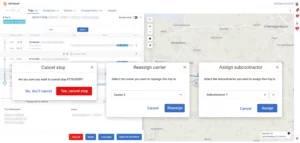
Transport Orchestration
Simacan’s Transport Orchestration is the central component of a modern transport management platform, providing seamless collaboration and secure data sharing within and across supply chains.